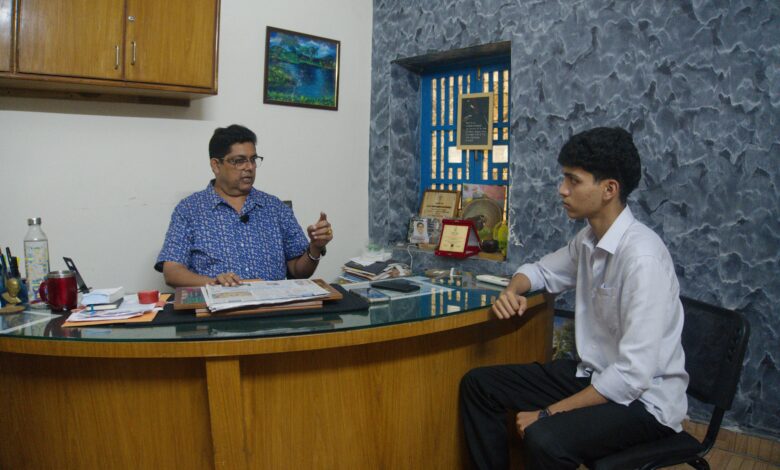
Reginaldo Lourenco: From Self-Made Grit to Public Service
When I travelled to Goa to meet Aleixo Reginaldo Lourenco, I expected a conversation about politics, development and the journey of a four-time MLA. After all, here was a man who had navigated business, political rivalries and the corridors of power. But as our conversation unfolded, I discovered a story that began long before the Assembly, in the years when people laughed at his ambitions and he had little more than the determination to prove them wrong. What stayed with me was not merely what Reginald had built, but what he is working to strengthen: a Curtorim where agriculture, public services and opportunities for young people are supported by institutions and systems that can endure.
When Everyone Else Was Laughing
At around 19, Reginald made a decision that would shape his life. He wanted to earn his own money rather than depend on his father. Small contracts came first, followed by stone crushing and real estate. In his early twenties, he borrowed money, started small and worked towards something bigger. There was no grand assurance of success, and certainly no guarantee that the risks would pay off-only the raw grit of a self-made entrepreneur who refused to back down. People laughed at his first stone crusher. They laughed at his office. They even questioned his efforts to establish a special school for children with disabilities. Yet Reginald remembers those reactions not as reasons to retreat, but as fuel to continue. “Everybody laughed at me,” he recalled. Their laughter became part of the story he was determined to rewrite.
The school, in particular, revealed a side of him that business figures alone cannot explain. He helped establish its initial structure and arrange its registration before handing its daily operations to the St. Vincent de Paul organisation. The intention was to give the institution continuity beyond the person who started it. He continues to support the school, demonstrating a principle that would later reappear in his vision for Curtorim: building something matters, but ensuring that it survives matters even more.
A Political Journey He Never Planned

Reginald describes himself as a politician “by mistake”, but one who is at the service of the people 365 days a year, 24 hours a day. His entry into the Zilla Panchayat came in 2000, followed by his election as MLA in 2007. He went on to win again in 2012, 2017 and 2022. But the journey between those milestones was not always smooth.
Building early enterprises in Goa required navigating a complex commercial landscape. When business hurdles appeared, rather than getting entangled in prolonged friction, Reginald made a decisive pivot of stepping away from private ventures to pour his absolute focus into public life. It was a defining turning point that forged his reputation for absolute independence, teaching him early on that true political resilience means standing your ground when the pressure peaks.
That same independence naturally shaped his evolution from mainstream party platforms to standing as an independent force. For Reginald, public service has never been about rigid partisan loyalty; it has always been about what works for the ground. By choosing to build constructive working relationships with the ruling administration to clear long-pending local hurdles, like a much-needed primary health centre and a local police station, he proved a rare political truth. In Curtorim, politics isn’t measured by the volume of the noise, but by whether everyday problems actually get solved.
The Fields He Refuses to Let Die
Then our conversation turned to agriculture, and the story took a different direction.
For roughly two decades, Reginald says, farmers in Curtorim have received assistance with free tilling and harvesting. Tractors and power tillers help where machinery can reach; in low-lying fields where it cannot, support is extended towards manual labour. Seeds and fertiliser have also been provided at times. The effort is rooted in a concern that is easy to overlook amid political arguments: when farming becomes too expensive across Maina, Raia, Curtorim, Rachol, and Camurlim, the fields may eventually be abandoned.
But Reginald does not want the arrangement to depend forever on his personal intervention. He has proposed a rice mill that could help farmers receive a better price for their paddy, an assured support price of ₹30 to ₹35 per kilogram, shielding them from market volatility. He also wants a verification system to ensure that the higher payment reaches farmers who actually cultivate the land. His ambition stretches across Maina, Raia, Curtorim, Rachol and Camurlim. He wants agriculture to remain part of the constituency’s future, not merely a memory of its past. The deeper challenge is to create a system capable of sustaining itself, so that farmers receive dependable support through institutions and processes, not only through individual intervention.
That is an ambitious proposition. It requires more than goodwill: it requires sound finances, dependable administration and a structure that can endure. Yet it is precisely this long-term thinking that gives the proposal its significance. Reginald is not simply talking about helping farmers through another season. He is working to ensure that farming remains viable season after season, with the infrastructure, technology and dependable support farmers need to keep cultivating their land.
Building Something That Outlives You
Reginald’s wider vision includes improvements to public services and infrastructure, from healthcare to essential facilities. And he is already working towards a stronger future on two connected fronts: agriculture and youth empowerment. A proposed rice mill, better support for paddy farmers and technology-enabled farming, including the use of drones, are part of the effort to make agriculture more viable. At the same time, he is focused on helping young people build a future through skills, guidance to secure relevant education and pathways to sought-after international opportunities in culinary arts and hospitality, tourism and cruise services, alongside grassroots entrepreneurship. He also wants young people and Gen Zs to participate meaningfully in shaping manifestos and in decision-making. The young man who once wanted to stand on his own feet is working to help build institutions, processes and systems that can stand on their own.
His advice to young people is uncomplicated: work hard, remain focused, do not be distracted by criticism, and never sacrifice integrity for shortcuts. Faith, too, remains central to his outlook. “You have to do your best and God looks after the rest,” he says.
As I reflected on our conversation, I returned to the image of those early years: a young entrepreneur pursuing ideas that others found amusing, continuing even when encouragement was scarce. Today, Reginald’s challenge is to turn that same determination towards building institutions, processes and systems that make public service more effective and enduring. Starting something requires courage; making it last requires an entirely different kind of commitment.
His ambition is about using public life and the office he holds to strengthen service to people, through more sustainable agriculture, better opportunities for young people and systems that continue to deliver beyond individual efforts. If Curtorim’s fields are still being cultivated years from now, supported by dependable structures and technology, and the youth thrive with employment & livelihood opportunities, that will be a lasting measure of the work underway.