MOG SUNDAY: Goa Writers Explore Desire, Land and Identity in Latest Anthology
~ The anthology hopes to resonate with readers that there’s so much more to Goa beyond food, restaurants, tourism and beaches.
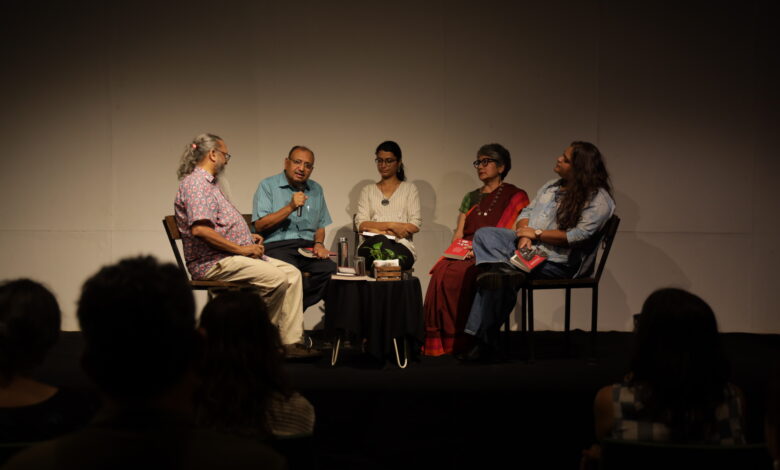
Panaji, February 2026: Moving beyond the familiar imagery that often defines Goa in the public imagination, writers from the Goa Writers Group examined how desire shapes contemporary life in the state, from marriage and migration to land, tourism and faith, during a recent MOG Sunday session at the Museum of Goa.
The session at the Pilerne-based museum centred on Appetite: New Writing from Goa, an anthology of essays, short stories and poems edited by Shivranjana Rathore and Tino de Sa, and published by Penguin Random House recently. The collection brings together voices connected to Goa, each responding to the theme ‘appetite’ in distinct ways.
Opening the discussion, the editors reflected on how the idea of appetite extends beyond food. “Appetites are not just about hunger,” one of the editors noted during the conversation. “They are about longing — for love, for land, for power, for belonging.”
Rathore described the theme as emerging organically within the group, but said it resonates strongly with the present moment in Goa. “There’s a hunger for Goa that exists everywhere — from the inside, from the outside, from everywhere,” she said, suggesting that the anthology attempts to examine how that desire is lived, negotiated and sometimes resisted.

She clarified that the editors did not approach the project with the intention of defining Goan identity. “We did not set out to represent anything,” Rathore said. “In the intention of not wanting to represent… I think that in itself is resistance and subversion.” By foregrounding intimate, personal narratives rather than spectacle, she argued, the book shifts focus away from commodified images of the state.
With rapid social and economic shifts, Rathore noted that the collection captures Goa across time. “We have a beautiful sense of temporality in the pieces,” she said, explaining that contributors move between past inheritances, present realities and imagined futures. That layering, she added, allows the anthology to reflect changing lifestyles, migration patterns and evolving aspirations without prescribing a single viewpoint.
Furthermore, Rathore drew a distinction between revenue-driven growth and more holistic approaches that consider land and ecology. While the anthology does not advocate policy positions, she said it “holds a container for all those layers and tensions,” acknowledging the structural forces that shape individual lives.
Co-editor Tino de Sa echoed the idea of appetite as cyclical and layered. Speaking about his poem ‘Bread Upon the Waters’, he said, “A poem belongs to the reader,” emphasising that its meaning shifts with interpretation. Using a deck of cards as a metaphor, he described appetites as impulses that enter and exit one’s life, only to return in altered forms.
The discussion also touched on literature’s role in a fast-moving media environment. Rathore described the present as a “hyper-propaganda era,” arguing that writing can slow down perception. “What any work of writing does is capture a moment,” she said, adding that documenting lived experience opens space for reflection rather than reaction.
For Goan readers, she expressed hope that the anthology offers recognition. “I hope people feel seen,” she said, referring to stories that explore community pressures, work in the tourism economy and shifting definitions of belonging. For readers beyond the state, she suggested the book may complicate familiar narratives. “I love restaurants. I love food. But there’s so much more to a place,” she remarked.