
Chinmaya Damodlekar’s ‘Halucify’ Explores Technological Addiction and Escapism
November is observed as Men’s Mental Health Awareness Month, with International Men’s Day celebrated on November 19. While mental health affects individuals irrespective of gender, societal taboos and deeply ingrained gender stereotypes often discourage people, particularly men, from expressing their emotional struggles. As a result, many feel compelled to conceal their vulnerabilities behind a façade of happiness, silently battling challenges that remain unseen.
Mental health has increasingly emerged as a significant theme in Goa’s Gen Z cinema, with young filmmakers exploring psychological struggles, emotional vulnerability and personal experiences through films such as Rishi, Unspoken, Sherine’s Intermission, Kabir Aur Ruhani, Ruschel and Smoke and Mirrors, among others.
Halucify is a short film directed by Chinmaya Damodlekar. Exploring the themes of technological addiction and emotional escapism, the film examines the growing dependence on technology among young people and its impact on their relationship with reality, memories and emotions. The film features debutante Roosevelt D’Souza as Neil Fernandes, Rameez Shaikh as Archie Daymond D’Souza and Roshni Maurya as Roshni Aurora.
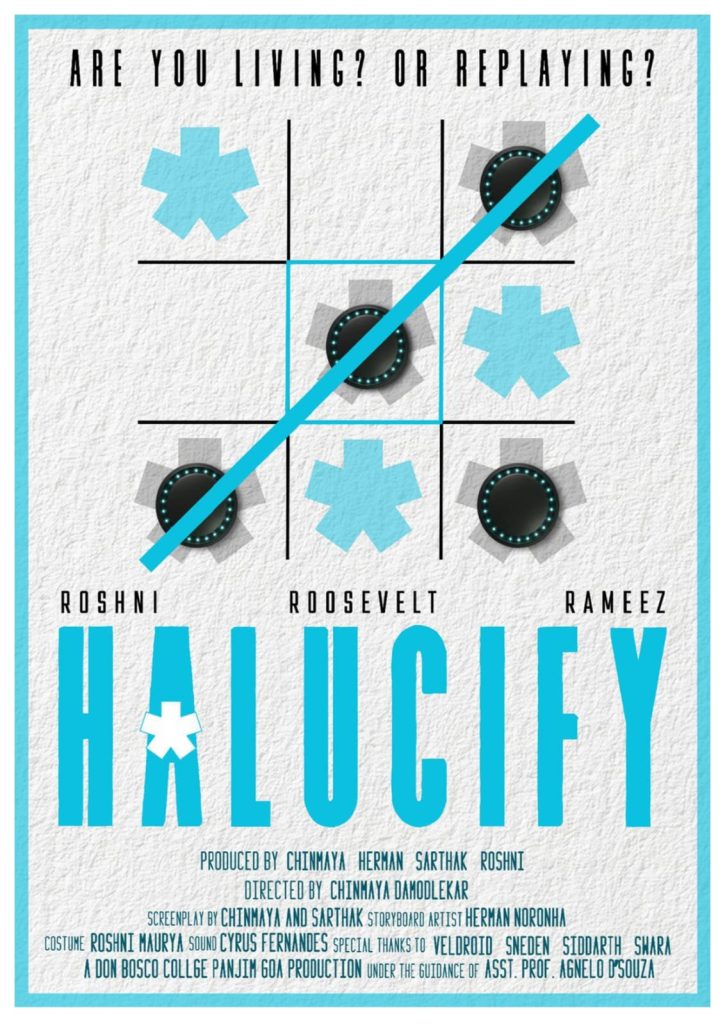
The creative team is led by Chinmaya Damodlekar and Sarthak Kuncolikar, who have jointly worked on the screenplay. The film’s storyboard was conceptualised by artist Herman Noronha, while Roshni Maurya handled costumes and Cyrus Fernandes took charge of sound. The project was developed under the guidance of Agnelo Raymond D’Souza.
Although Halucify marks Chinmaya Damodlekar’s directorial debut, it is not his first association with cinema exploring mental health and psychological themes. He previously portrayed the parallel lead, Dr Jay, in the psychological thriller Smoke and Mirrors, which explored Capgras syndrome, alongside Varun Thanki and Prachi Shirodkar. He also played Dhruv opposite Varada Godkar, who portrayed Esha, in The Rental Chapter, a film centred on loneliness and friendship.

Debutante Roosevelt D’Souza portrays Neil Fernandes, the protagonist of Halucify. A student at Tempe, Roosevelt brings emotional depth to the character, capturing Neil’s gradual transformation from initial curiosity to technological obsession. His performance explores the psychological vulnerability and internal conflict that lie at the heart of the narrative.
Roshni Maurya portrays Roshni Aurora, Neil’s former love interest. Her character represents emotional balance and a more responsible relationship with technology. Through her portrayal, she adds another dimension to the narrative, highlighting the contrast between healthy engagement with technological innovation and emotional dependence on it. The film also marks Roshni’s return to filmmaking following her performance in Rishi, which explored themes of loss and moving on.
Rameez Shaikh plays Archie Daymond D’Souza, Neil’s friend, who initially orders the Halucify device but chooses not to use it himself. Balancing his professional commitments with academics, Rameez brings a grounded and realistic presence to the character. Archie serves as an important narrative contrast, illustrating how individuals can respond differently to the same technological innovation.
Interestingly, the character’s name is a playful reference to two college professors, Archie Fernandes and Agnelo Raymond D’Souza. Rameez is also an established filmmaker with experience in socially relevant films exploring mental health and other social concerns. He previously directed Unspoken, which explored unemployment, among other subjects.
At the centre of Halucify is a fictional wearable device that allows users to relive their past memories through an immersive experience. Through Neil’s journey, the film examines how unresolved emotions, nostalgia and an attachment to the past can make individuals vulnerable to technological escapism.
What begins as curiosity gradually develops into an obsession, drawing attention to the thin line between cherishing memories and withdrawing from present-day reality.
The fictional device serves as a metaphor for modern digital platforms that encourage users to revisit old memories, conversations and relationships. By presenting this idea through an imagined technological invention, the film offers a commentary on contemporary patterns of technology consumption and the growing dependence on digital experiences among young people.
Through Neil’s character, the narrative explores how emotional vulnerability and an inability to move beyond the past can contribute to an unhealthy dependence on technology. Rather than portraying technology as inherently harmful, Halucify raises questions about how individuals use it to cope with their emotions and whether digital experiences can sometimes become substitutes for meaningful engagement with reality.
By blending fiction with social relevance, Halucify aims to create awareness about the consequences of excessive technological dependence. Its research-informed approach to digital addiction, combined with a fictional narrative, makes the project an attempt to engage audiences with an increasingly relevant concern among today’s youth.
As Goa’s emerging generation of filmmakers continues to explore subjects beyond conventional storytelling, films such as Halucify demonstrate how young cinema can become a platform for conversations around mental health, technology and the complexities of human emotions.